


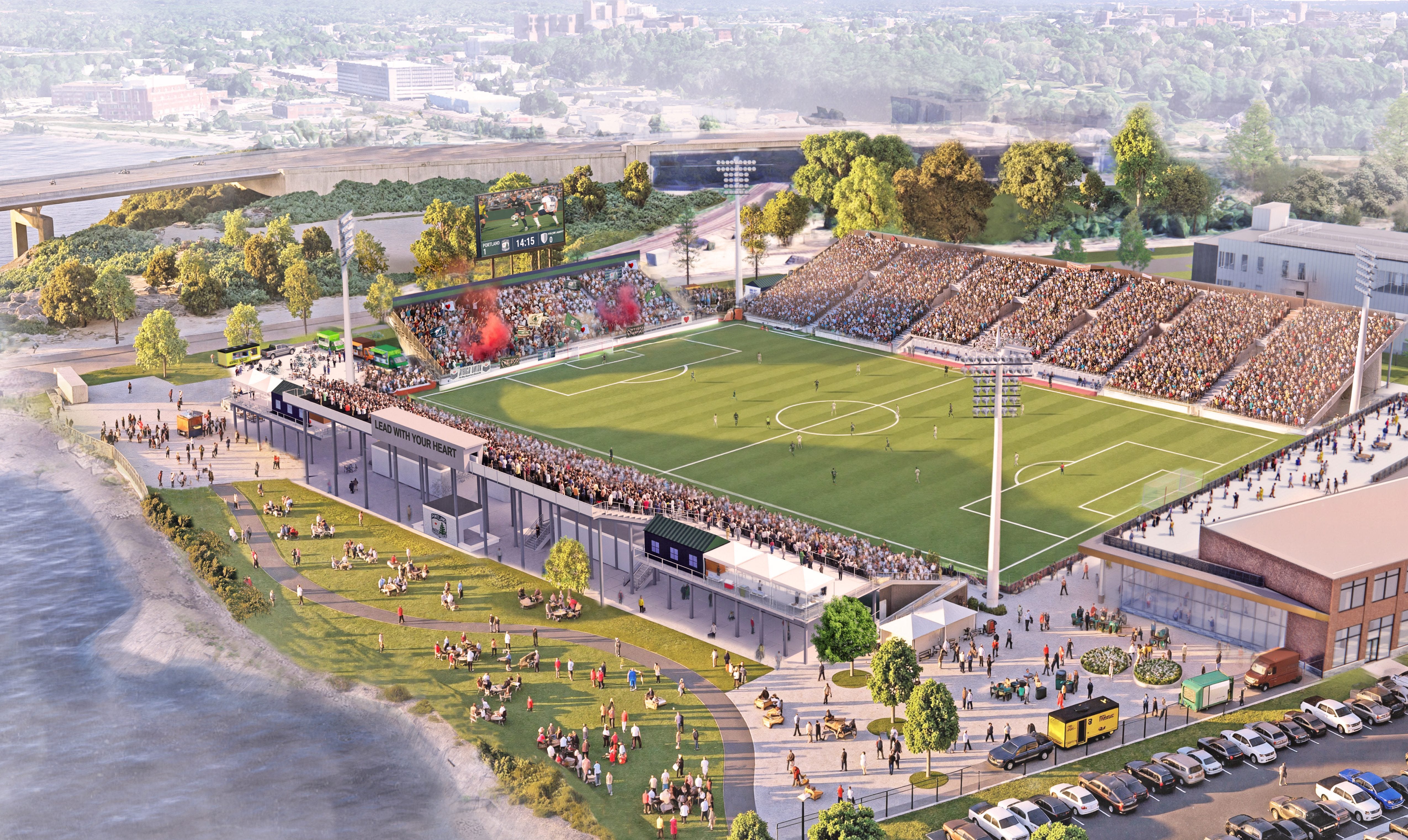
As part of the Portland Planning Board’s two workshops on the Soccer Club of Maine’s request for a zoning change at Cassidy Point for a new stadium, the public was encouraged to send in written comments of support or opposition.
By The Hearts’ Beat’s count, 125 written comments were submitted. It is an encouraging sign that so many people took part in the process, which is how local democracy is supposed to work.
It’s also important to note that many commenters don’t live in Portland. Supporters wrote from Westbrook, Windham, Biddeford, Scarborough, Farmington and Lebanon. Opponents wrote from Yarmouth, Freeport, Perry, Stonington and Brownfield. That reflects the debate itself, a statewide fan base for the Portland Hearts of Pine and Maine Wildness on one side and a statewide maritime industry on the other. The two sides also differ in who they are: Supporters are mostly individual fans and residents, while opponents are mostly maritime businesses, trade groups and two state agencies.
Following the second workshop, held Tuesday, we at The Hearts’ Beat felt it was important to share some of the commentary with readers as a sampling of what people think about this project.
People took the time to write in, and that matters. Certainly, some of the comments were part of a coordinated campaign to oppose or support the project. But either way, their comments may help guide the Planning Board in its recommendation on the zoning change, which will then be sent to the City Council for a final decision. You can also read our story from the first workshop here and our look at the project as a whole.
A total of 73 of 125 submissions were in favor (58%), 49 were against (39%) and three took no clear side (2%). Because listing 125 comments would be unwieldy for readers, we are publishing comments proportionally, which means publishing nine for and six against. The three that took no side round to zero.
What follows are the selected comments. Readers who want to see all the comments can find the first batch here and the second here.
Support:
1. David Glendon, chairman, Sprague Operating Resources (property owner)
“The persistent decline in cargo operations and limitations of the Cassidy Point infrastructure, coupled with the recently passed ban on coal storage, have severely constrained the viability of the site for marine industrial purposes.”
“From 30-40 vessels annually at the Merrills terminal in the early 2000s, the terminal served less than 10 by 2020, necessitating a major reduction in force.”
“Unfortunately, the Merrill’s terminal was built to serve a market that no longer exists, and alternative industrial uses are not viable at the site.”
2. David Farmer, George Street, Portland
“I’ve lived in Portland for 24 years, and during that time I have not seen an organization accomplish what the Hearts of Pine have accomplished.”
“They have built an enduring sports franchise by creating a community. The matches are electric, and a boon to the city.”
“The goal of preserving the working waterfront is important, but it’s also important for a city to grow and change. When the city passes ordinances that de-industrialize an area, they are asking for an alternative use. The Hearts of Pine have done the work to develop an appropriate alternative.”
3. Paul Styslinger, Neal Street, West End
“Cassidy Point has been closed to the public for decades. The plan adds public pathways along the river, a riparian restoration zone, and a trail connection between the Fore River Parkway Trail and West Commercial Street that would close a gap the Comprehensive Plan specifically identifies.”
“Few peninsula sites are large enough to host this excellent future asset, and a stadium near the Fore River Parkway Trail and planned bus service will let many of us walk, bike, or take transit to games.”
“In 2015, the Council took a similar approach at 58 Fore Street, extending mixed-use zoning over the upland and port zoning over the waterfront portion.”
4. Sean Dundon, former Planning Board member
“Rezoning WPDZ to B-5 and allowing a ‘Stadium’ as a permitted use in B-5 presents a superior opportunity for proactive land reuse under Portland’s ReCode initiative compared to a traditional brownfield site or the existing (and banned) industrial land use.”
“Industrial properties like active or former coal storage yards are increasingly incompatible with modern urban health and aesthetic goals.”
“A stadium acts as a regional anchor, creating immediate economic synergy that an isolated brownfield cleanup cannot match.”
5. Matthew Winch, architect, and Jennifer Garrett
“These amendments will help drive a new and important redevelopment of the Portland Waterfront that is fully consistent with the City of Portland’s Comprehensive Plan and create a new and important economic driver for the city.”
“As evidenced by the redevelopment along the eastern waterfront two things can be simultaneously true. The waterfront can be maintained and an economic blight such as bulk coal storage can be replaced with a far more valuable and sustainable long-term commodity.”
“...keeping the door open to further waterfront development if the deep water pier ever realizes the substantial investment it would need to simply stabilize the failing pier there.”
6. Hayley McKinnon, Storer Street, West End
“There are many days throughout the summer when I can’t even take my dogs for a walk because the air is so thick with fossil fuel fumes. On more than one occasion, I have helped my elderly neighbors inside after they quite literally choked on the air while gardening in their backyards.”
“I’ve spoken to 35 residents and neighbors here in the West End, and every single person is tremendously grateful to the Hearts for committing to cleaning up and transforming Cassidy Point into a vibrant asset for the city and our community.”
“Between 2025 and 2026, I’ve attended approximately 10 Hearts of Pine games, and never once experienced an issue with parking, traffic, or transportation.”
7. Mark Johnson, Commercial Street
“While I understand concerns about potential changes to the historical working waterfront, I believe the new stadium appropriately balances the city’s downtown development goals with a desire to protect harbor jobs.”
“Based on current Hearts fan attendance at Fitzpatrick Stadium matches, it appears that a 10,000 seat stadium with about 80% arriving at games via private car would require 3,000+/- parking spots within walking distance of the stadium.”
“I have to believe that adequate parking can be found among the VA, Northern Lights, MaineMed, Tyson, the new train station, etc parking lots (especially since the vast majority of the teams’ matches will take place on Saturday and Sunday nights, when the lots should be relatively empty)...”
8. Craig Gray
“As a longtime wheelchair user, I have learned that there is an enormous difference between simply being able to enter a place and truly feeling that you belong there.”
“At its matches, I have experienced a remarkable feeling of community – people of different ages, backgrounds and abilities coming together around something that feels distinctly ours.”
“For people with disabilities, thoughtful access to seating, circulation, transportation and the waterfront itself can determine whether we are merely accommodated or are genuinely part of the community.”
9. Sean Daly, The Valentine Band, Section 119
“I’m one of the many soccer fans that followed Portland’s journey to professional soccer for years before it became reality, filling out surveys and making suggestions.”
“I am a 54 year old white male, and statistics suggest that I am not likely to make too many close friends at this point in my life. And yet, over the past 2 years, I have made more friends than anytime in my life since college.”
“I look forward to a stadium that is large enough to contain the joy that my bandmates (bandits, if you will) and I bring to every game. And I look forward to it being at Cassidy Point, a neglected piece of waterfront that will be elevated by its association with the Hearts.”
Opposition:
1. Bill Needelman, former city waterfront coordinator, 2014 to 2025
“The proposal to amend the Portland Zoning Map and B-5 text to allow a soccer stadium and associated development on Cassidy Point in the Waterfront Port Development Zone represents the largest potential retreat from working waterfront protections in the history of Portland Zoning.”
“We all love the Hearts. However, the Port is the true heart of the City.”
“Cassidy Point is not a coal pile. Cassidy Point is the only bulk and break bulk deepwater terminal in the largest port in the State of Maine.”
“Left alone, the pier is positioned to become an economic orphan destined to a future of disinvestment and eventual obsolescence.”
2. Chelsea Pettengill, executive director, Maine Port Authority
“I would ask the Planning Board to consider the implications of abandoning a century of working waterfront preservation in favor of a team that has existed for two years, especially given the economic implications.”
“In 2025 the Port of Portland conducted $3.77 billion in trade while (a) recent news release from the mayor’s office attributes a 2025 economic impact of $16.5 million to the Hearts of Pine.”
“...the reality is that a marine facility must be located on the waterfront with deep-water access and multi-modal freight connectivity to exist, while a soccer stadium does not.”
3. Calvin Klopp, president, Portland Pilots
“...while we understand the pier itself will be retained, from a maritime commerce perspective, it would be considered useless without the adjacent terminal acreage it currently maintains to conduct cargo operations.”
“To insinuate that any deepwater marine terminal is not economically feasible is categorically false.”
“In short, the Hearts of Pine franchise will succeed in any location, whereas port operations cannot.”
4. Nicholas Walsh, maritime attorney, Propeller Club board member
“Since 1650 it has been the case that when one Port of Portland shipping sector declines, new opportunities appear, keeping the port active.”
“The resulting zoning cannot work if a waterfront property owner whose pier is seeing less demand is allowed to cry poverty and demand a zoning change.”
“Sprague knew, when it acquired Cassidy Point, of the restrictive zoning, yet it now seeks to sell at top dollar to a developer whose use would have nothing to do with water.”
5. Molly Salt, Dartmouth Street
“The site presents several distinct logistical, financial, and environmental challenges that make it ill-suited for a venue of this scale.”
“...the surrounding infrastructure is insufficient to safely handle the ingress and egress of up to 11,000 spectators.”
“Given Portland’s current municipal budget pressures, shifting these infrastructure burdens onto local tax bases raises significant fiscal concerns.”
6. Vinny O’Malley, longshoreman, ILA Local 861
“The 1987 Working Waterfront referendum won with a 2 to 1 margin, and in 2022, 72% of voters supported Portland’s working waterfront.”
“I am also a strong supporter of local sports teams, including the Hearts of Pine. But the idea of removing any piece of waterfront commerce is an existential threat to all those who earn their living from waterfront sources.”
“If we lose access to this critical piece of infrastructure it will certainly put pressure on other pier owners to rethink their commitment to our working waterfront, which really does put the ‘port’ in Portland.”
Editor’s note: Minor spelling, punctuation and grammatical errors in the original comments have been corrected; the excerpts are otherwise as written.