


PORTLAND, Maine – The Planning Board heard contrasting assessments about the city’s waterfront economy during Tuesday’s second workshop on the Soccer Club of Maine’s plans to build a new soccer stadium at Cassidy Point.
Waterfront Coordinator Heather Moretti, the city staffer whose job is to promote balanced economic development along Portland’s working harbor, described the protected waterfront as a major and growing economic engine, backed by heavy public investment and squeezed for space at the International Marine Terminal, the state’s only container terminal.
Meanwhile, the soccer club’s economic development consultant, Tom Dworetsky, painted a different picture, stating that Cassidy Point’s cargo business collapsed long before the stadium was proposed and that reviving it would require costly reinvestment no one has committed to, so the stadium is a credible reuse of the upland.
Both made compelling arguments, but collectively, it brought to mind the adage popularized by Mark Twain: “There are three kinds of lies: lies, damned lies, and statistics.” Now, no one is being accused of lying here, but listening to such opposing arguments about the current and future economic viability of the waterfront made for a surreal scene at the workshop for the Planning Board, which has been tasked with reviewing the soccer club’s zoning change request for Cassidy Point. Zoning changes are required for the soccer club to be permitted to build its stadium.
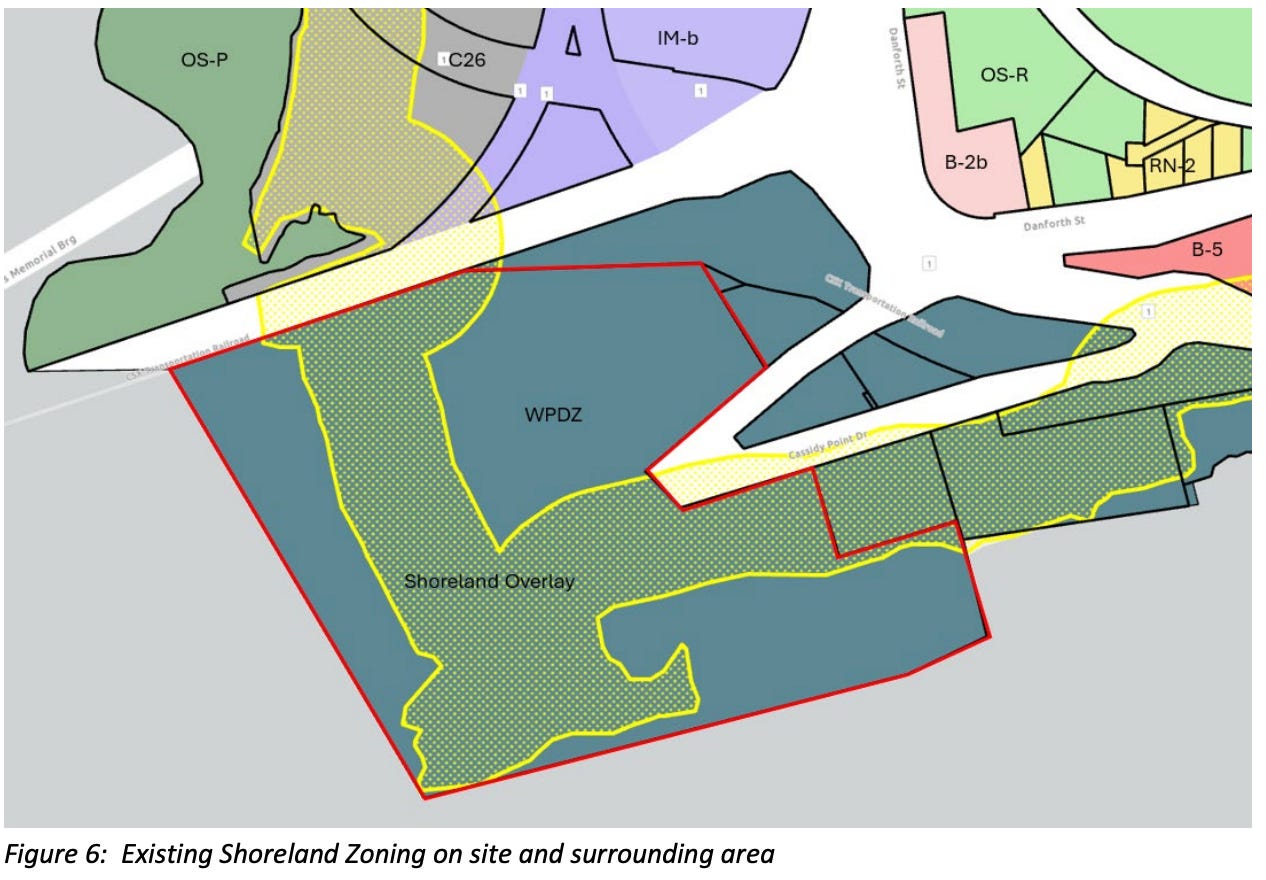
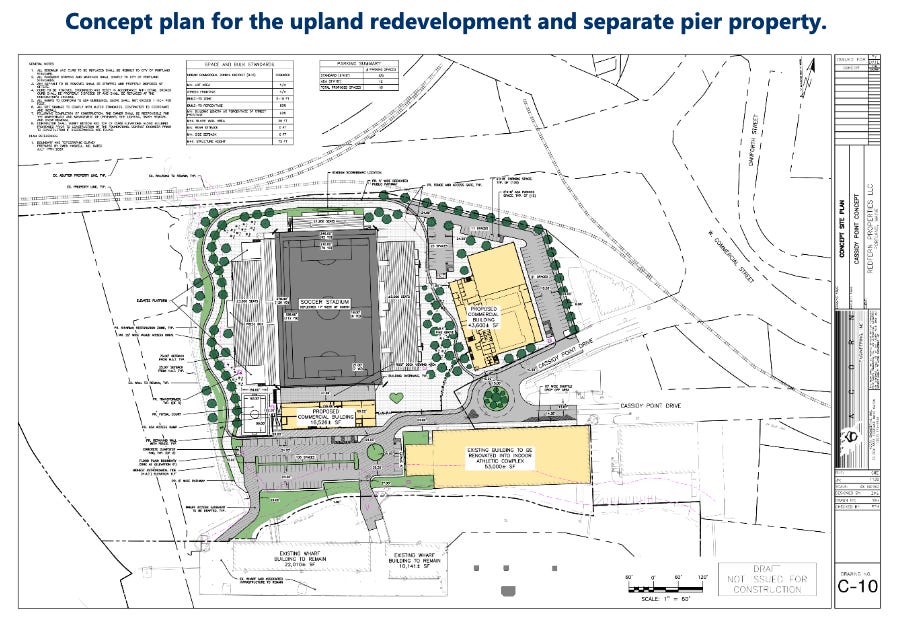
The stadium proposal splits Cassidy Point in two: the pier parcel, made up of the 600-foot pier and a strip along the water’s edge, would stay zoned for marine use, while the upland, the yard and warehouse land behind it where cargo has been unloaded and stored, would be rezoned for the stadium.
The soccer club, which has an agreement to acquire the property from the current owner, Sprague Energy, is asking the city to rezone most of the parcel from the Waterfront Port Development Zone to the B-5 Urban Commercial Zone and to add “stadium” as a permitted use. Along with the stadium, the plans call for a pedestrian pavilion, commercial buildings and an indoor athletic facility in an existing warehouse. The southern and western edges of the site, including the 600-foot pier, would remain in the marine-industrial zone and be sold separately to McAllister Towing. The site has long held Sprague’s coal pile, which a 2025 city ordinance requires to be covered by 2027 and removed by 2030.
Mary Costigan, a lawyer representing the soccer club, told board members that they were receiving a wealth of information but reminded them that their task at hand was to review “whether zoning is pursuant to and consistent with the Comprehensive Plan.”
As the club’s presentation showed a graphic, Costigan added: “That’s not an easy thing to do, so the (Maine) Law Court has done that for you. And the law court has said that … rezoning has to be in basic harmony with the Comprehensive Plan.”
The Planning Board’s role is to offer its recommendation on the zoning request, which would allow the club to build a $50 million stadium that could host 9,000 to 11,000 people for the Portland Hearts of Pine and Maine Wildness. The board’s recommendation then goes to the City Council, which has the ultimate authority on any change.
Representatives for the soccer club argued in their presentation that the rezoning is consistent with the Comprehensive Plan.
“There’s a reasonable economic case for allowing the stadium proposal on the upland while keeping a separate pier,” said Dworetsky, a vice president with Camoin Associates. “That doesn’t mean that there’s no industrial demand in Portland or that no future industrial use would work here, but rather the market evidence doesn’t support an economic case for an industrial use of that portion of the site.”
While Moretti didn’t say whether the rezoning fits the plan, she stressed that the zoning on the western waterfront bars any use that would displace or unreasonably interfere with existing marine operations, and that the neighboring International Marine Terminal is already out of room. In her submission to the Planning Board, she cited the city’s Land Use Code: “No use shall be permitted in the [Waterfront Port Development Zone] if it will have an adverse impact on future marine development.”
The Waterfront Port Development Zone is the zoning district covering Portland’s western waterfront along the Fore River, including Cassidy Point and the International Marine Terminal. It’s one of the city’s three waterfront zones, along with the Eastern Waterfront Port Zone and the Waterfront Central Zone.
Moretti added that a 2020 study found marine businesses on the Portland side of the waterfront “generate over $650 million in revenue and provide for over 2,200 jobs.” She also noted that Maine has more than 5,000 miles of coastline, and only 20 miles of working waterfront.
The workshop was also the first time for the Planning Board to hear in person from someone with Sprague. Jim Therriault, head of the company’s material handling division, told the board that Sprague had investigated every possible option for the property but none were financially viable.
“We do have a plan, we think, to preserve everything we currently do, and have the same growth capacity we currently do, and not impact the working waterfront directly,” Therriault said, explaining that Sprague can move its business to its South Portland facility.
Across the Planning Board’s two workshops on the proposal, the first held Sept. 22, the city has received 125 written submissions from supporters and opponents of the project, according to a count by The Hearts’ Beat, with 73 for it, 49 against and three that took no clear side.
The club’s presentation listed more than 20 locations across Greater Portland that it considered before settling on Cassidy Point. In September, co-founder Jonathan Culley said Cassidy Point was the only available site that fit.


During Tuesday’s workshop, speakers on both sides of the issue addressed the Planning Board. While their views on the location of the stadium differed, the one consistent message was that they supported the soccer club’s effort to build a new stadium.
The Planning Board’s next meeting is set for Dec. 8. The zoning change request is not yet on the agenda for the meeting, but officials with the soccer club have said they hope the matter will be discussed then.