


PORTLAND, Maine – Good luck finding anyone who opposes the Portland Hearts of Pine’s desire to build a new stadium.
But just like how thousands of soccer fans can watch a violent tackle and each have differing opinions on whether it was a foul or not, Mainers differ sharply on where that stadium should go.
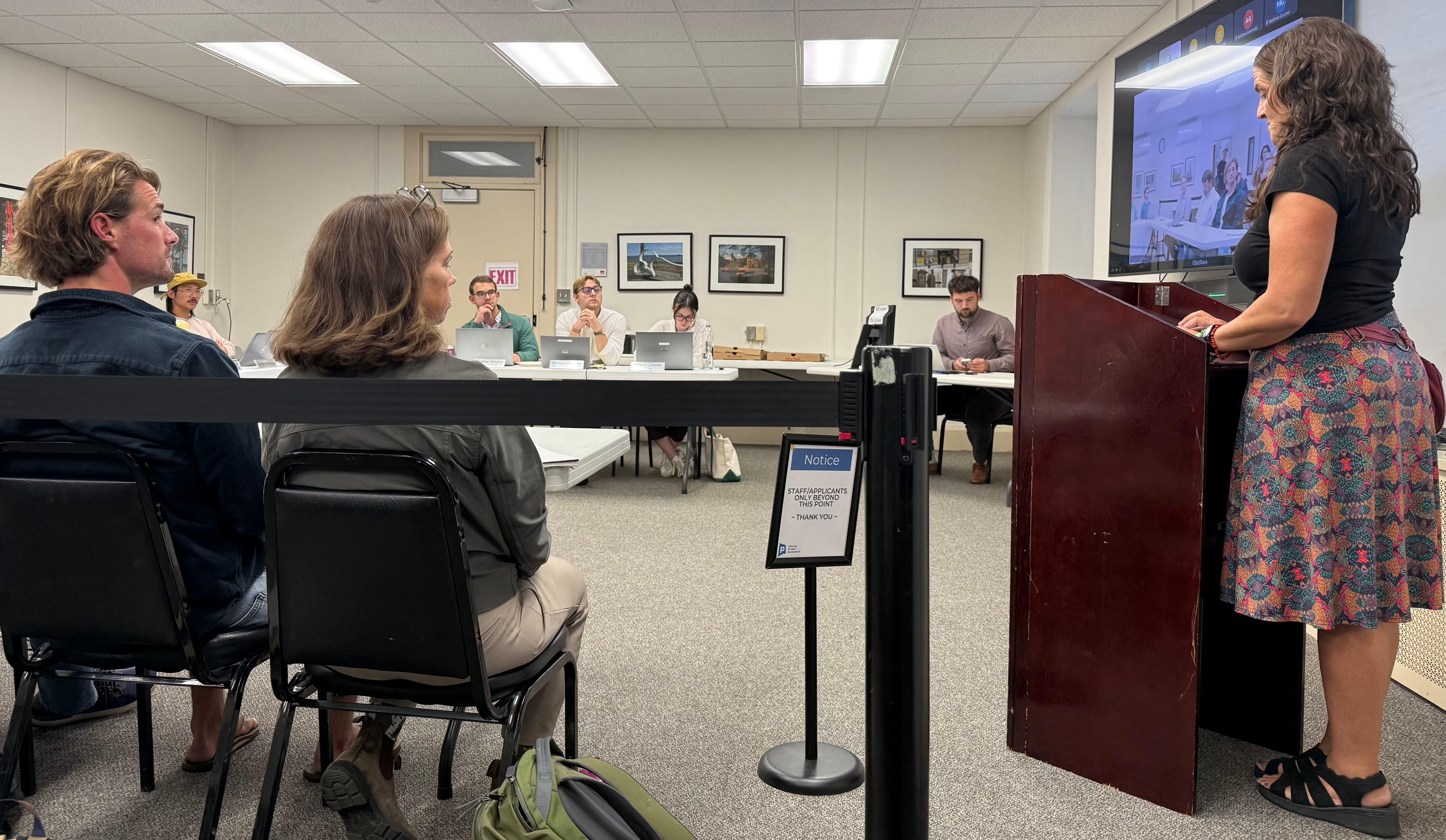
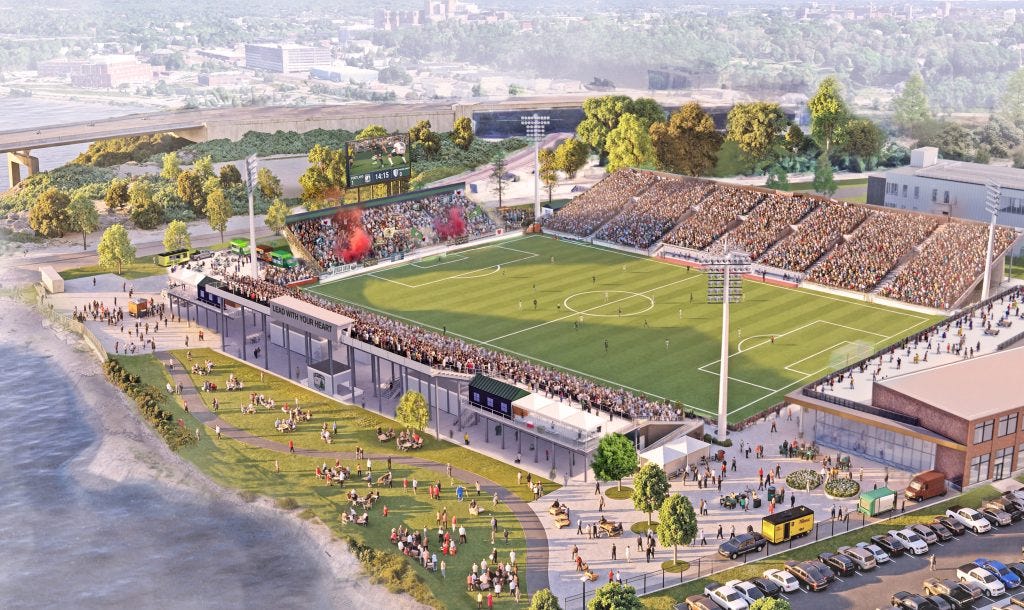
That was evident Tuesday night at the Portland Planning Board workshop at City Hall. Many of those speaking during public comment expressed their delight with the Hearts’ plan to build a $50 million stadium that could hold up to 11,000 people at Cassidy Point. Still others believe the location is a poor choice because they fear it will further reduce the city’s working waterfront, a contention that has been made for at least five decades and even led to a zoning change that the Hearts now hope to amend.
Planning Board Chairman Joseph Zamboni kicked off the meeting by explaining that there would be no votes taking place at the workshop, and that when the board eventually does, the vote will serve only as a recommendation to the City Council, which ultimately has the final decision on the zoning change request. City officials say they expect the Planning Board to be reviewing the project near the end of the year.
Zamboni appeared trepidatious about the potential for emotions from speakers during public comment and seemed to want to get in front of it.
“This is a volunteer board of people who live in the city,” Zamboni said. “We are here to talk to the city, talk to applicants, and hear feedback from folks.”
Planning department staff gave a detailed report on the Hearts’ application: the club wants the city to rezone most of the parcel from the Waterfront Port Development Zone to the B-5 Urban Commercial Zone and add “stadium” as a permitted use there. That would clear the way to buy the site from Sprague Energy and build a permanent soccer stadium, along with a pedestrian pavilion, commercial buildings, and an indoor athletic facility reusing an existing warehouse. The southern and western edges of the property, including a 600-foot pier, would remain in the marine-industrial zone and would be sold off separately to keep some working-waterfront use intact.
Sprague Energy has for years received and stockpiled coal at Cassidy Point. But the maritime footprint has been forced to rapidly change following persistent complaints from West End neighbors regarding windblown black dust. Last summer, the Portland City Council passed an ordinance requiring the coal pile to be completely covered by 2027 and banning bulk coal storage entirely by 2030.
Without giving any details, Jonathan Culley, a founding partner of the Hearts, addressed Sprague’s plans to sell.
“The intention is it’s not gonna be a bulk cargo pier anymore,” he said. “It will be used by a marine user for berthing. There should be an announcement on that in the coming days, but the intention is that this is not gonna be a bulk cargo terminal anymore.”
Culley discussed issues of transportation, the waterfront industry, and the economic benefits to the area.
“Our proposal would make this site productive again for the local economy, for the people of Portland, bringing a different type of economic vitality and new community energy to the west end of Portland,” Culley said. “The sports and recreation campus with public trails and waterfront access represents a far more progressive and optimistic and healthier future, one that allows for the environmental cleanup that the highly contaminated site desperately needs and that its neighbors deserve.”
Culley said the Hearts looked at more than a dozen locations in and around Portland. The only one that was both available for purchase that fit the club’s need was Cassidy Point, he said. Others that did not fit were around the Maine Mall, decommissioned oil tank farms in South Portland, and a farm in Westbrook.
“Keep in mind that to build a stadium in the suburbs or even off Peninsula Portland, we would need the roughly seven acres for the stadium, but also an additional 20 to 25 acres for a sea of asphalt parking,” Culley said. “That’s not what we want to do. The environmental case for an in-town stadium is extremely compelling with significant reduction in per capita carbon emissions.”
Culley noted that parking issues aren’t part of the zoning review, but he added that because the issue is so impactful, it was worth discussing as part of the process. The Hearts have hired VHB, a civil engineering company, to conduct a comprehensive traffic study, which it has already started with fan surveys at home games.
“We’ve learned that at two of our recent matches, 81% of our fans arrive at Fitzpatrick Stadium by private car with an average of 2.7 passengers per car,” Culley said. “This means that 19% of our fans arrive by walking, biking, or transit. We’ll be leaning heavily into strategies to increase this percentage. And in particular, we see a significant opportunity to increase the percentage of fans that arrive by transit at Cassidy Point.”
When addressing the waterfront industry, Culley said the Hearts have commissioned Camoin Associates, an economic development consulting firm, to analyze economic activity in the port and conduct a land inventory of waterfront parcels around the port, including on the South Portland side. It was not clear when that report will be complete.
“Camoin is planning to speak with key port stakeholders, including the Maine Port Authority, Eimskip, the largest cargo operator in Portland, labor unions, and others,” Culley said.
Hearts’ co-founder Gabe Hoffman-Johnson spoke passionately about the importance that Portland’s professional soccer team has become.
“When I think about Cassidy Point, I don’t think about it as a stadium,” Hoffman-Johnson said. “I think about it as a physical manifestation of our why. Seven years ago, professional soccer in Portland was just a dream. Today, it’s a community, one that has grown faster, reached further, and meant more to people than I could have ever imagined. And through all that, our purpose remains the same: Use the power of soccer to help build a better Portland and a better Maine.”
More than a dozen people spoke from the public. For those who oppose changing the zoning, the key point was echoed time and again: the maritime economy will be negatively impacted and any locations changed to non-maritime use will be lost to the industry forever.


Brian Downey, a Falmouth resident and retired Coast Guard officer who now does consulting in the maritime industry, lauded Hoffman-Johnson’s comments while adding that he appreciates everything the Hearts have brought to Portland. But he said he still opposes building at Cassidy Point.
“It’s very clear that after reading up on the code, that Cassidy Point is clearly protected from non-marine development,” Downey said. “I understand that’s why we’re here to discuss changing that. But I … just feel that if we change our zoning, that we’re going to lose a vital piece of the waterfront community that is rapidly decreasing and that we’re never gonna get it back.”
Also opposing the stadium was Bill Needelman, a former Planning Board member who previously served as the city’s Waterfront Coordinator, which is a municipal position within the Housing & Economic Development Department that oversees and protects the city’s maritime and commercial harbor interests.
“I think it is important to correct the record to a certain extent: Cassidy Point is not a former industrial facility, it is an active industrial facility, underutilized, but active,” Needelman said before then addressing the Hearts’ presentation that included the history of the waterfront. “The presentation showed Cassidy Point has had not just one life, it has had many lives, but it has been concentrated on the movement of goods in and out of the port. And it is the movement of those goods that has given it value.”
Jeff Storey, president of the Portland Longshoremen’s Association, said he believes that a maritime industry can still be successful at Cassidy Point.
“I love what these guys are bringing to town, but I love what we do in town as well,” Storey said. “In the last 10 years we’ve changed a lot on the waterfront. We’re growing, things are good. We need the space. Changing this zone at this time is the wrong thing to do.”
Many supporters of the zone change talked about how meaningful the Hearts have been to their families and the community as a whole. Others discussed how valuable it would be to have the Hearts in an easily accessible location.
Jill Perry said she supports the stadium at Cassidy Point specifically because of accessibility reasons.
“A stadium in the city means families and kids who may not have a car or an easy way to get somewhere outside Portland still have a realistic opportunity to be a part of this thing, and that is important,” Perry said. “The stadium gives Hearts room to grow and for so many local small businesses to grow with them.”
Sean Mahoney, a Falmouth resident, environmental law attorney, and the Conservation Law Foundation’s Maine vice president, said he worked closely with West End residents on the effort to reduce the hazards from the coal contained at Cassidy Point.
“This is one of the most exciting community-oriented brownfield projects that I’ve ever seen, professionally or personally,” Mahoney said. “I’m particularly excited about how this provides public access to the waterfront at that end of Commercial Street.”
Lauren Ostis, a Munjoy Hill resident and the community coordinator at East End Community School, said every day she sees the impact the Hearts have had on the city. Her family has already ridden bikes to games and she looks forward to making the ride to Cassidy Point.
“Having a permanent home stadium for this community is important to everyone who has already supported Hearts of Pine and for future fans who have yet to feel the magic,” Ostis said. “I’ve biked to many a Hearts’ game with my son and his friends, and we look forward to continuing such adventures on our way to the new stadium in the future.”
The Planning Board expects to have at least one more workshop on the Hearts’ application. That date has not yet been set.