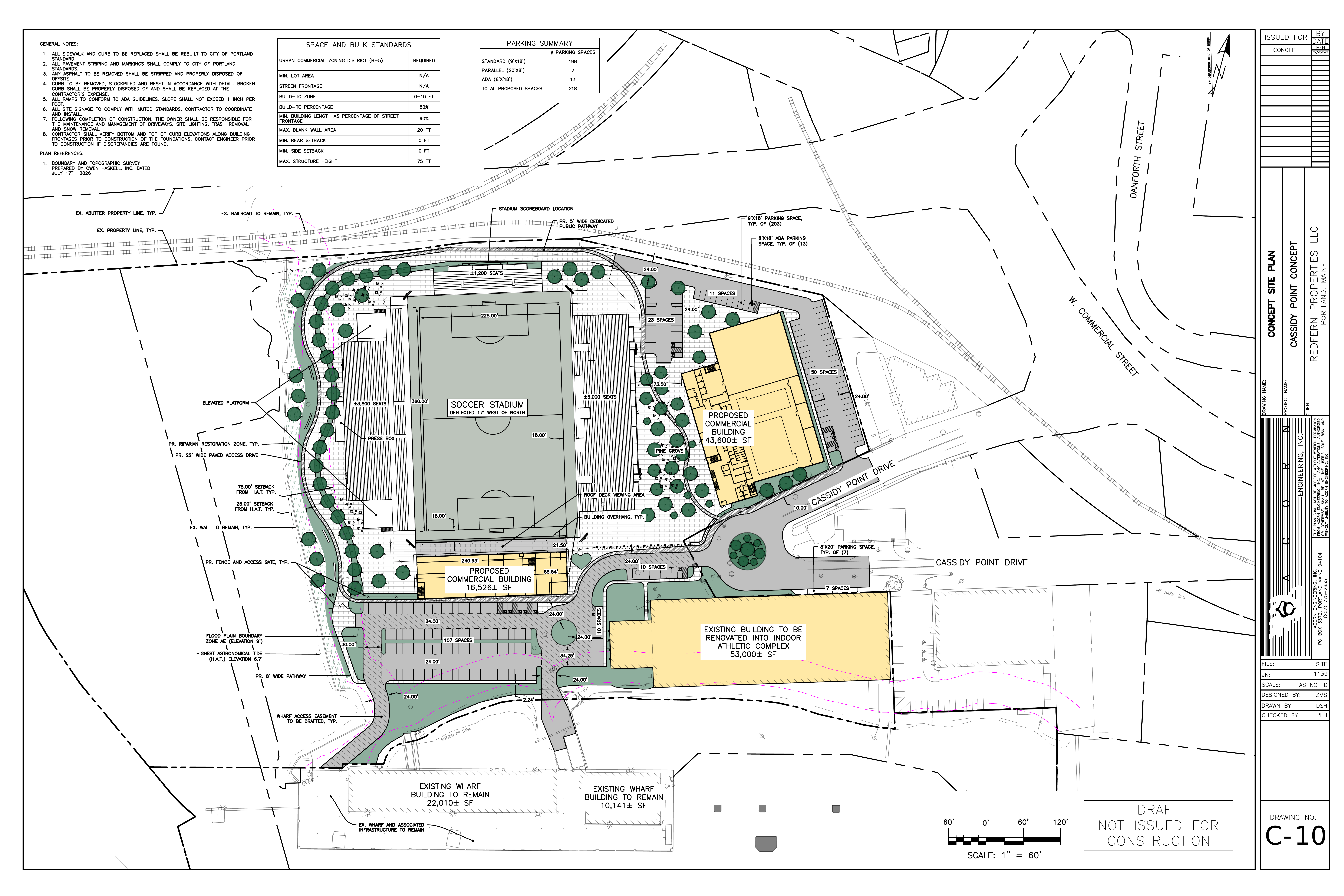

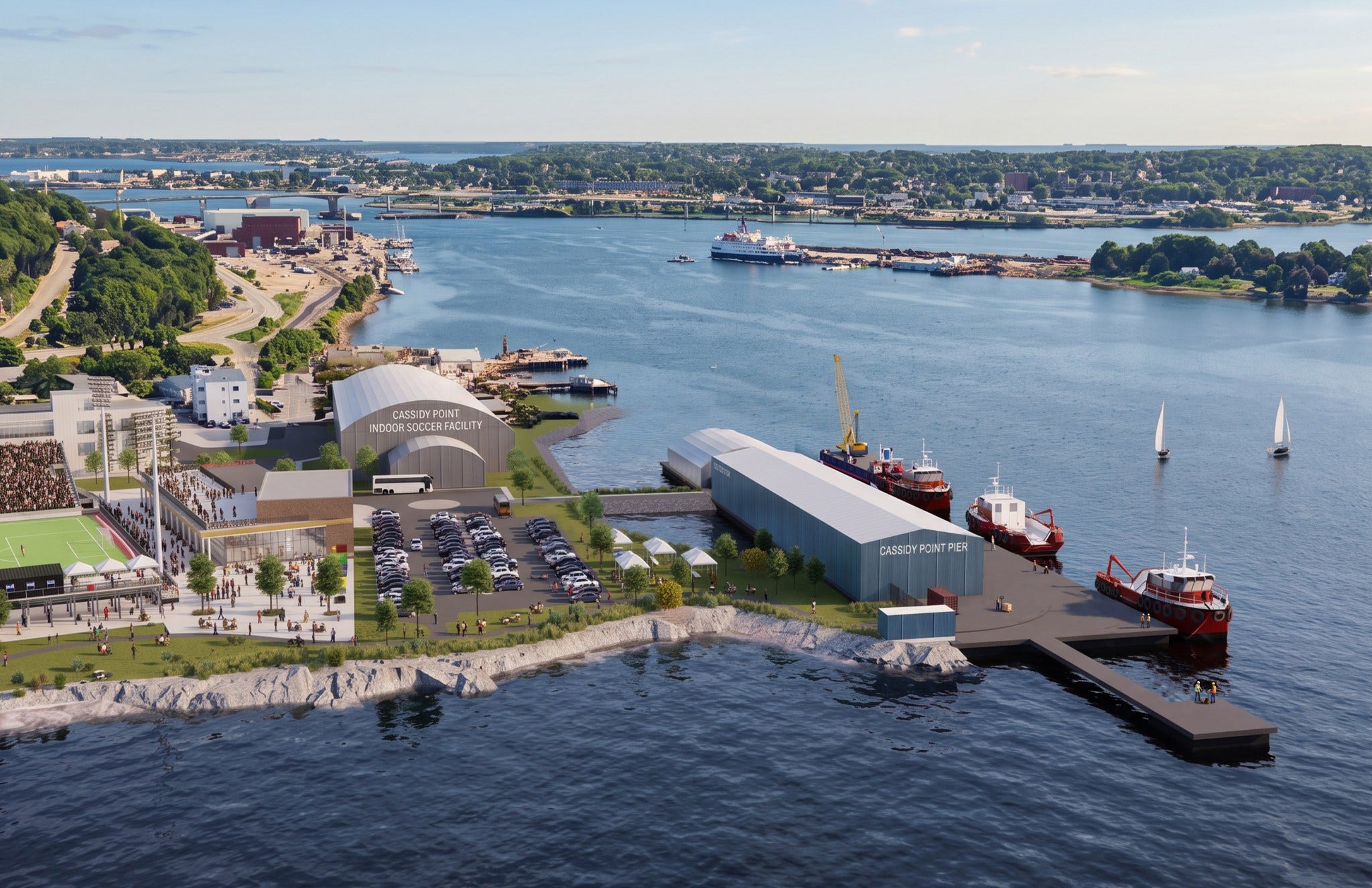
PORTLAND, Maine — New documents released by the City of Portland ahead of today’s Planning Board workshop show the Hearts of Pine club plans to raise its proposed stadium site at Cassidy Point from 9 feet to 15 feet for flood protection - and reveal that the property's current owner cites years of declining cargo traffic as its reason for selling.
The documents also show that the rationale of the seller, Sprague Energy, is directly challenged by Nicholas H. Walsh, a Portland-based maritime attorney who argues in a separate letter that an owner "crying poverty" over declining profits shouldn't be grounds for a zoning change.
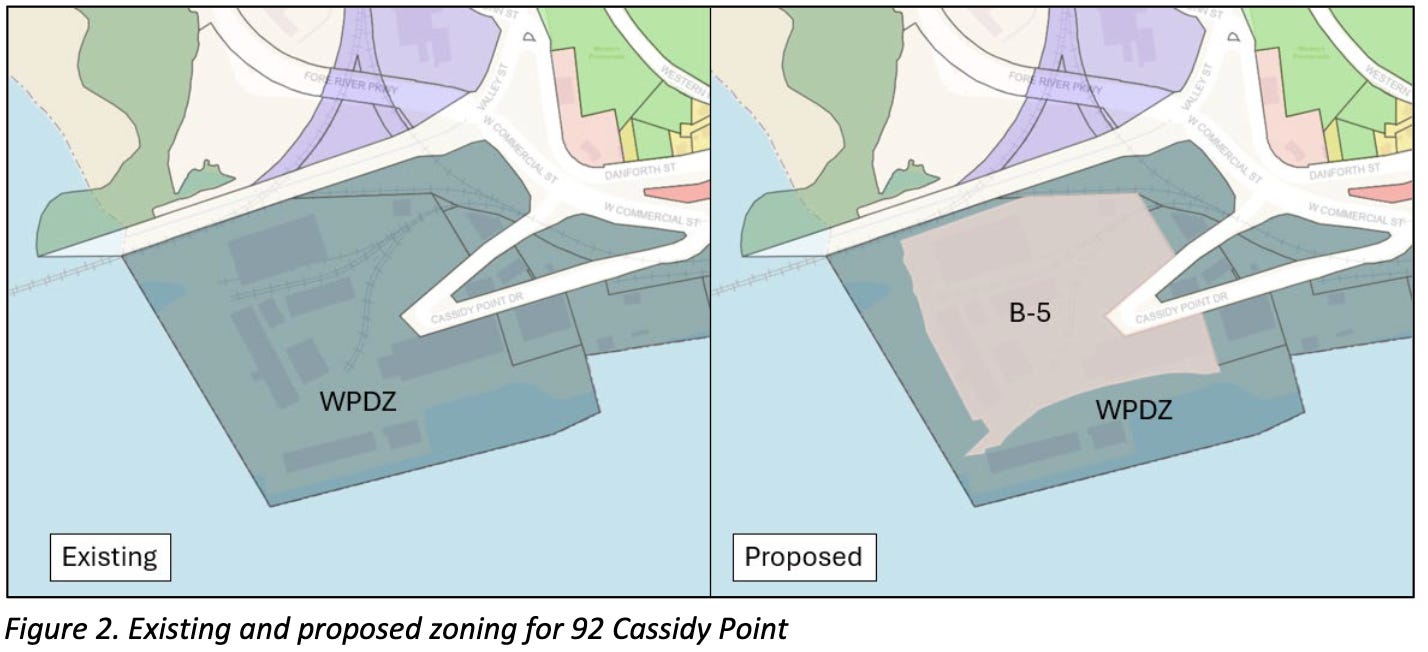
The 4:30 p.m. workshop at City Hall is the Planning Board’s first look at the Hearts of Pine’s request to change the property's zoning from a designation reserved for shipping and marine industry to a more flexible commercial zone that permits uses such as stadiums, retail, and restaurants. The Hearts are asking to remap most of the approximately eight acres of the Cassidy Point property from the WPDZ classification to B-5 and add the term "stadium" as a permitted use, ahead of buying the site and eventually building a $50 million soccer stadium for 9,000–11,000 seats. Commercial buildings and an indoor athletic facility are also planned.
“I do not expect them to take a vote on the proposal until near the end of this year,” Jessica Grondin, the city’s director of communications and digital services, said in an email about the Planning Board. “And then it will need to go to the full City Council for approval.”
Adding six feet of fill to the property would raise the land from nine feet to 15 feet, Will Savage, an engineer with Acorn Engineering, told an audience in August during a neighborhood meeting, according to documents submitted by the applicants.
“We are proposing to raise the site to elevation 15 (feet) – plus or minus a foot – to be out of the 100-year flood zone,” Savage said to the audience. “The elevation is based on a study completed by the City of Portland during the ReCode processes two years ago that estimated where the future flood elevation will be within the next 50 years.”
Editor’s Note: The neighborhood meeting minutes contain a disclaimer that questions and answers were not recorded verbatim but aim to represent and summarize actual questions, answers, and overall discussion. This story quotes directly from the minutes.
Pete Heil, a civil engineer with Acorn, added that raising the property’s height is not required but will be undertaken “to protect the investment.”
Because the Hearts’ application is strictly for a zoning change, there are no specific details about raising the property’s height. Those would come later when the Hearts submit a major site plan application.
As part of the city’s gathering of public comments, Sprague Energy Chairman David Glendon wrote that the company supports the zoning change that would allow the Hearts to build a stadium and create a compelling community destination while boosting the region’s economy.
“The persistent decline in cargo operations and limitations of the Cassidy Point infrastructure, coupled with the recently passed ban on coal storage, have severely constrained the viability of the site for marine industrial purposes,” Glendon wrote. “With the exception of the pier, which will continue in marine industrial use following the sale to another waterfront user, the remainder of the property is best suited to be rezoned to allow for a stadium and mixed-use development.”
There are no public details on how much it would cost the Hearts to purchase the property.
Portland passed a community-backed ordinance banning waterfront coal stockpiles in August 2025. Sprague is legally required to cover the pile by 2027 and have it entirely carted off-site by 2030.
In his letter, Walsh invoked Chandler's Wharf, a 1980s residential condo conversion on the working waterfront that caused public backlash and directly led to a voter referendum that created the city’s current protective waterfront zoning. Walsh called the Hearts’ proposal a repeat of the exact mistake that zoning was built to prevent.
“The resulting zoning cannot work if a waterfront property owner whose pier is seeing less demand is allowed to cry poverty and demand a zoning change,” Walsh wrote. “Sprague knew, when it acquired Cassidy Point, of the restrictive zoning, yet it now seeks to sell at top dollar to a developer whose use would have nothing to do with water.”
Walsh also argued that the proposed retention of tug berthing “is a red herring, for without the upland component, allowing for storage of bulk cargoes and transshipment to and from trucks and rail cars, the site can never be a freight terminal.”
Altogether, 53 entries were made for public comment. A total of 32 supported the zoning change and 19 opposed. Additionally, the Waterfront Alliance asked for the project to be delayed for further study and one writer asked for adjacent property to also be rezoned from WPDZ to B-5.
One intriguing dynamic to the request is the opponents clearly don’t object to the Hearts getting a new stadium, just the location, because they worry about the loss to the city’s vital working waterfront.
Also in the report:
Parking issues were not a significant portion of the zoning application, but club officials did discuss them during the neighborhood meeting. Jonathan Culley, co-founder of the Hearts franchise, told the audience, “We have preliminary agreements with the VA Clinic, owned by JB Brown for about 500-plus spaces, Mercy Hospital lots for another 300-plus spaces. We have talked to Tyson Barber Foods, Portland Yacht Services, Maine Medical garage and have identified a total of about 1,500 spaces that will be available for our events.”
When asked at the neighborhood meeting about the value of the site and whether it will be taxable property, Culley said it was “too early to tell and we’re not prepared to respond to that.”
During the neighborhood meeting, one attendee asked whether music or festivals could be an eventuality at the stadium. Culley answered there are no concerts anticipated at this time, but added "we never want to say ‘never.'" Another attendee asked about fireworks, and co-founder Gabe Hoffman-Johnson said there are no plans for them.
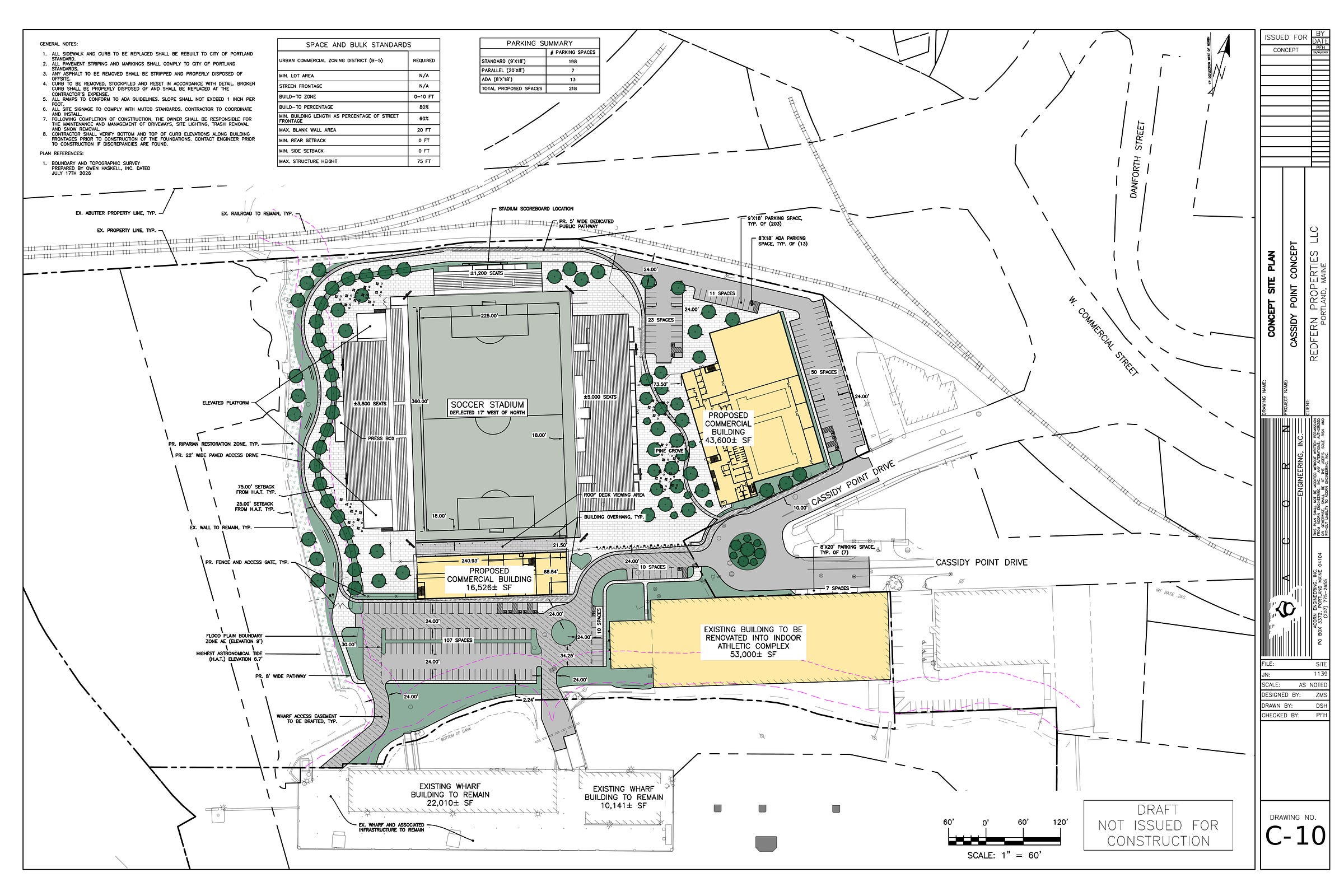
This image is the concept site plan for Cassidy Point, which lays out how the developers plan to completely transform the waterfront parcel if the city approves the zoning changes. Image: Portland Planning & Urban Development Department